Alteromonas Ferment Extract in Winter: Does the Marine Ingredient Really Help Against Central Heating?

Note: Image partly or fully created with AI.
In short
Alteromonas ferment extract in winter can be a sensible building block, but it is not a miracle cure: there are few independent human studies on the ingredient itself. It is, however, well documented that dry central heating air stresses the skin barrier. What matters is a routine of moisture, lipids and a good indoor climate.
Alteromonas ferment extract in winter at a glance
- Origin/INCI: fermentation product of the marine bacterium Alteromonas, found in Cosmenia's The Hydrating Serum (COSMOS Organic)
- Well documented: low humidity increases water loss from the skin and changes the stratum corneum
- Partly documented: soothing properties of an Alteromonas exopolysaccharide (laboratory findings, manufacturer information)
- Not documented: that the extract alone "repairs" winter skin – our research found no independent human studies
- Use: morning and evening after cleansing, followed by a lipid-rich cream
What is Alteromonas ferment extract?
Alteromonas ferment extract is an ingredient obtained by fermenting bacteria of the genus Alteromonas. Such microorganisms are usually cultivated in bioreactors rather than harvested from the sea. The extract contains metabolic products of the bacteria, in the literature mainly complex sugar compounds (exopolysaccharides). You can read more about the basic idea in our article on Alteromonas ferment extract.
An important caveat: "Alteromonas ferment extract" describes the origin, not an exactly defined substance. Depending on the bacterial strain and process, the constituents differ.
What happens to your skin in winter – and what can the ingredient do about it?
Central heating stresses the stratum corneum
Heated indoor air often has only 20–30% relative humidity. A laboratory study in the International Journal of Cosmetic Science (2025) exposed reconstructed human epidermis to dry air for one hour. Result: water loss and permeability rose, and expression of the structural proteins filaggrin and loricrin as well as the tight-junction proteins claudin-1 and ZO-1 decreased. The amount of ceramides stayed unchanged. A review in the Journal of the European Academy of Dermatology and Venereology (2016) paints a consistent overall picture: low humidity and cold impair barrier function. We explain this in more detail in Central heating and skin.
What has been published on Alteromonas
The publicly available literature is thin. A structural analysis in Carbohydrate Polymers (2012) describes an exopolysaccharide from Alteromonas macleodii originating from hydrothermal vents in the East Pacific. The authors mention that it is marketed commercially as a cosmetic ingredient to soothe sensitive skin. The study itself, however, provides chemical structure data, not proof of efficacy in humans. Whether this substance is identical to the extract in a particular product cannot be derived from it.
Critical assessment: what the studies really show
Two things are often mixed up. First: that dry air stresses the skin is well documented – although partly from cell models that cannot be transferred one to one to your everyday life. Second: that a particular ingredient cushions this effect needs its own evidence. For Alteromonas ferment extract we found no independent, controlled human studies on skin barrier or winter skin in PubMed. Statements such as "promotes filaggrin formation" come mainly from manufacturer and in-vitro data and should be regarded as preliminary.
That does not mean the ingredient is useless. It means that the effect of a product never depends on a single ingredient. In a formulation like the Hydrating Serum, hyaluronic acid, glycerin and plant lipids (glycolipids) play a part too – their role in moisture binding and barrier care is far better documented. As with any cosmetic product, under the EU Cosmetics Regulation (EC) No 1223/2009, claims must be substantiated.
Winter routine in practice
Cleanse without drying out
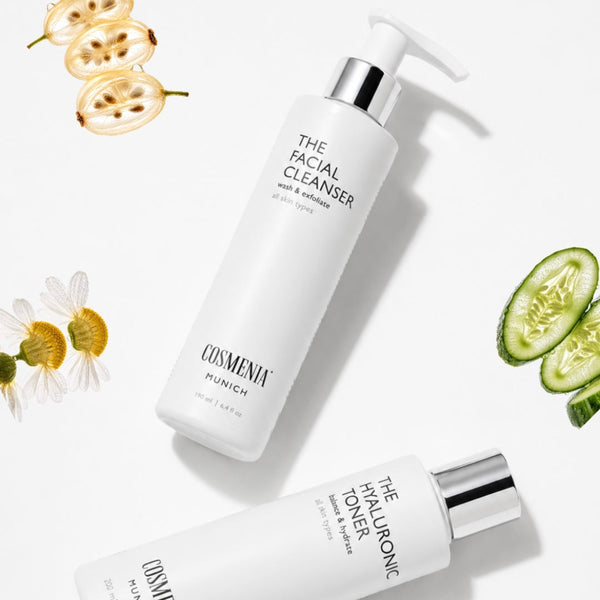
Lukewarm water and a mild cleanser such as The Facial Cleanser are usually enough. Hot water and strongly degreasing surfactants worsen water loss.
Serum on slightly damp skin
Apply The Hydrating Serum morning and evening after cleansing, onto slightly damp skin. Hyaluronic acid binds water, but in very dry air it can only show its benefit in combination with a sealing cream.
Finish with lipids
Next comes The Day Cream with plant lipids and sea buckthorn. In the evening, something richer is fine, such as The Beauty Sleep Cream & Mask. If you want all three steps matched to each other, you will find them in the Hydra Barrier Repair Set.
Don't forget the indoor climate
A hygrometer shows whether you are within the recommended range of 40–60%. Regular airing and a moderate heating temperature help more than any serum alone.
Frequently asked questions about Alteromonas ferment extract in winter
What does Alteromonas ferment extract do in skincare?
It is used as a soothing, barrier-supporting ingredient. The evidence comes mainly from laboratory and manufacturer data; we found no independent human studies.
Is Alteromonas ferment extract suitable for sensitive skin?
It is often formulated for sensitive skin. Whether a product is well tolerated by you, however, depends on the entire formulation. Test new skincare on a small patch of skin first.
Can central heating really weaken the skin barrier?
Yes. Laboratory studies show more water loss and altered barrier proteins in reconstructed skin after just one hour of dry air. In everyday life, cold, cleansing and skincare also play a role.
Is a serum enough in winter?
Usually not. A serum supplies moisture, while a cream with lipids reduces water loss. Only both together make a sensible winter routine.
Is the ingredient from the deep sea?
Some Alteromonas strains originally come from the sea, but the extract is usually obtained by fermentation in bioreactors.
Conclusion
Alteromonas ferment extract in winter is an interesting but insufficiently documented building block. Don't rely on a single ingredient: the strain dry air puts on the skin is well documented, and moisture, lipids and a better indoor climate help against it. As part of such a routine, The Hydrating Serum fits well – as a complement, not a replacement.
Sources
- Izutsu-Matsumoto Y. et al.: Effect of low humidity on the barrier functions of keratinocytes in a reconstructed human epidermal model. International Journal of Cosmetic Science 47(3), 2025, pp. 523–534. DOI: 10.1111/ics.13048
- Engebretsen K. A. et al.: The effect of environmental humidity and temperature on skin barrier function and dermatitis. Journal of the European Academy of Dermatology and Venereology 30(2), 2016, pp. 223–249. DOI: 10.1111/jdv.13301
- Le Costaouëc T. et al.: Structural data on a bacterial exopolysaccharide produced by a deep-sea Alteromonas macleodii strain. Carbohydrate Polymers 90(1), 2012, pp. 49–59. DOI: 10.1016/j.carbpol.2012.04.059
- Regulation (EC) No 1223/2009 on cosmetic products (Art. 20, product claims)
As of: November 2026
Want to see more from COSMENIA in your Google search results? Add us as a preferred source.


Comments