
Coconut Oil on Your Face: Skincare Miracle or Pore-Clogger? What the Research Shows

Note: Image partly or fully created with AI.
The short answer
Coconut oil nourishes dry body skin and can slow down moisture loss. On the face, however, it is controversial: it is considered comedogenic and can clog pores if you have combination skin or are prone to blemishes. What is well documented is its effect on dry skin – not its benefit as a facial moisturiser.
Find out more about blackheads, shine and pores in our blemish-prone skin guide.
Coconut oil at a glance
- Origin/INCI: fat from the flesh of the coconut, INCI: Cocos Nucifera Oil
- Main components: around 90% saturated fatty acids, mainly lauric acid (approx. 45–50%)
- Well documented: care for dry skin, protection against moisture loss
- Partly documented: supportive care for mild to moderate eczema (study in children)
- Not documented: anti-ageing effect, acne treatment, meaningful UV protection
- Use: solid at room temperature (liquid from approx. 24 °C); use sparingly on the face and not if you are prone to blemishes
What is coconut oil?
Coconut oil is a plant fat obtained from the dried flesh of the coconut. Unlike most plant oils, it consists of around 90% saturated fatty acids, which is why it is solid at room temperature. That makes it very stable against oxidation, but also heavy: it forms a dense film on the skin. Shea butter, which we have already reviewed critically, behaves similarly.
Refined coconut oil is odourless; virgin coconut oil smells of coconut and contains more accompanying substances. Both qualities are permitted in certified natural skincare, but there coconut oil is usually used not pure but as part of creams or in the form of derivatives.
What the research really shows
Dry skin and eczema: solid but limited
Coconut oil is best studied for dry skin and eczema. In a randomised, double-blind study by Evangelista et al. (2014) with 117 children with atopic dermatitis, virgin coconut oil was compared with mineral oil. After eight weeks, the SCORAD severity score fell by around 68% in the coconut oil group and by around 38% in the mineral oil group. That is a clear difference, but it concerns children's body skin under medical supervision. It cannot simply be transferred to adults' faces.
Blemish-prone skin: no evidence of efficacy
In the lab, lauric acid works against the acne bacterium Cutibacterium acnes. This gave rise to the idea that coconut oil helps against spots. However, clinical studies proving a benefit for acne are lacking. On the contrary: on common comedogenicity scales, coconut oil is usually rated 4 out of 5, i.e. strongly pore-clogging. These scales mostly come from older animal models and are only a rough guide. Dermatologists nevertheless usually advise against applying pure coconut oil to blemish-prone facial skin.
Anti-ageing and sun protection: marketing
Claims that coconut oil smooths wrinkles or protects against UV radiation are not supported by robust studies. Its natural light protection is far below any relevant SPF. Learn more about what really matters for UV protection in our article on mineral and chemical sunscreen.
Coconut oil on the face: who it suits and who it doesn't
More suitable
Very dry, rough skin without a tendency to blemishes can benefit from a small amount, for example on dry patches or as lip and hand care in winter. The oil does not provide water, it keeps it in the skin. It should therefore always follow a moisturising layer, for example The Hydrating Serum.
Less suitable
For combination skin, oily skin or a tendency to blackheads and spots, pure coconut oil on the face is usually not a good choice. Here a light, oil-free moisturiser such as The Glowy Gel with aloe vera and zinc is the easier option. Coconut oil is also often recommended as a make-up remover, but it leaves an oily film that has to be removed thoroughly. Our article on double cleansing explains how gentle cleansing works.
The better alternative for the barrier
If you want to support your facial skin barrier, a balanced formula of lipids and water-binding ingredients usually serves you better than a single fat. One example is The Day Cream with plant lipids and sea buckthorn.
Our recommendation
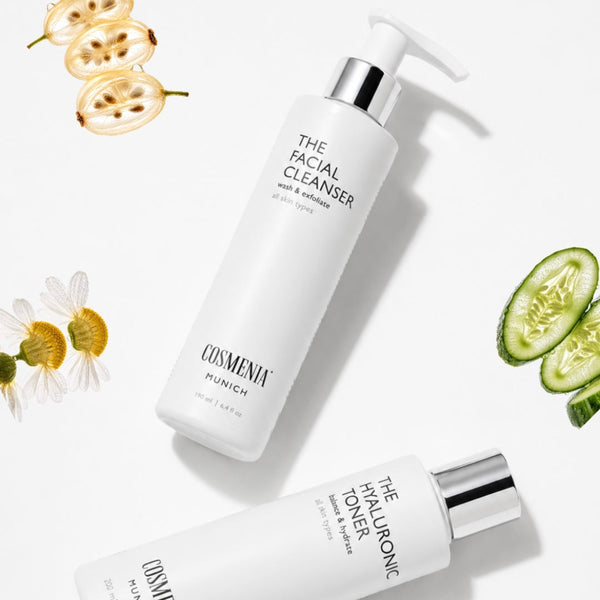
If you are prone to blackheads or have combination skin, the Clear Skin Set is the right routine: the mild Facial Cleanser with lactic acid cleanses thoroughly, the Hyaluronic Toner provides moisture and the oil-free Glowy Gel with zinc PCA balances – without any heavy oils. If your skin tends to be dry, The Hydrating Serum with hyaluronic acid and plant lipids adds the moisture that coconut oil cannot provide on its own.
Frequently asked questions about coconut oil on the face
Does coconut oil clog pores?
Coconut oil is usually rated as strongly comedogenic. If you are prone to blemishes it can clog pores; many people with dry skin tolerate it well. Your individual reaction is what counts.
Is coconut oil good for spots?
No, there is no clinical evidence for this. Lab findings on antibacterial lauric acid cannot be transferred to an effect on acne.
Can I use coconut oil as a moisturiser?
Only to a limited extent. It reduces water loss but contains no water-binding substances. It is better to apply a serum first, then an oil or cream.
Is coconut oil suitable as a make-up remover?
It dissolves make-up well but leaves an oily film. For sensitive or blemish-prone skin, a mild cleanser such as The Facial Cleanser is the better-tolerated choice.
Conclusion
Coconut oil is an effective nourishing fat for dry body skin, but no cure-all for the face. The research supports caring for dry skin, but not promises about acne, wrinkles or sun protection. If you are prone to blemishes, you are better off with a well-thought-out, oil-free routine such as the Clear Skin Set rather than pure coconut oil on your face.
Sources
- Evangelista M. T. et al.: Comparison of the effect of the topical application of virgin coconut oil and mineral oil on atopic dermatitis in children. International Journal of Dermatology 53(1), 2014 (DOI: 10.1111/ijd.12339)
- Study summary on MDedge: Virgin coconut oil bests mineral oil in dermatitis/xerosis (mdedge.com)
As of: November 2026
Want to see more from COSMENIA in your Google search results? Add us as a preferred source.


Comments