

Double Cleansing: Worth It or an Unnecessary Trend?

 The short answer
Double cleansing combines an oil-based and a water-based cleanser and removes make-up, sunscreen and sebum more thoroughly than a single cleansing step. It makes most sense in the evening if you wear make-up or mineral sunscreen. For dry, sensitive or blemish-prone skin, however, daily double cleansing can overload the skin barrier – here, a mild cleanser is often enough.
What's behind the concept?
Double cleansing combines two cleansing steps with different principles. First, an oil- or balm-based product dissolves oil-soluble residues such as make-up, sebum and mineral sunscreen – oil binds oil, and water-soluble cleansers alone can hardly reach these residues. The second step is a water-based, usually mild cleanser that removes water-soluble impurities such as sweat and remnants of the first cleansing step. The method originally comes from Korean and Japanese skincare, but has now become an established part of many evening routines in Europe as well.
Who is double cleansing useful for?
The benefit depends heavily on your skin's condition and daily exposure. If you wear make-up or long-lasting sunscreen every day – mineral sunscreen in particular – you'll benefit from two cleansing steps in the evening; a single mild cleanser often removes such residues only incompletely, which in the long term can clog pores and encourage blemishes. For very oily or blemish-prone skin, too, the additional deep cleanse can help to keep excess sebum under better control.
It's a different story for dry, sensitive or irritation-prone skin, and on days without make-up or sunscreen. Here, a single, mild cleansing step is usually perfectly sufficient – extra cleansing brings no measurable added benefit but increases the risk of a damaged skin barrier.
A critical look: where double cleansing can harm the skin
Cleansing is one of the most common causes of a weakened skin barrier – and double cleansing doubles this effect if not done correctly. Surfactants can remain in the top layer of the skin even after rinsing and gradually dissolve lipids and proteins there that are actually meant to keep moisture in the skin. With cleansing that is too frequent, too intensive or wrongly combined, this shows up as dryness, tightness, redness or increased sensitivity to active ingredients applied afterwards.
The concept itself isn't the problem – what matters is how it's done. Aggressive, heavily foaming surfactants in the second step, hot instead of lukewarm water, vigorous rubbing or daily double cleansing without any real need are the actual risk factors. Many dermatologists therefore don't recommend double cleansing across the board, but situationally: when the day's cleansing load actually requires it, not as a fixed part of every evening routine.
Adding double cleansing to your routine gently
Step 1: oil or balm cleanser for make-up and sunscreen
The first step dissolves oil-soluble residues without drying out the skin. A gentle, circular massage instead of rubbing is important so that mechanical irritation doesn't occur.
Step 2: a mild, water-based cleanser
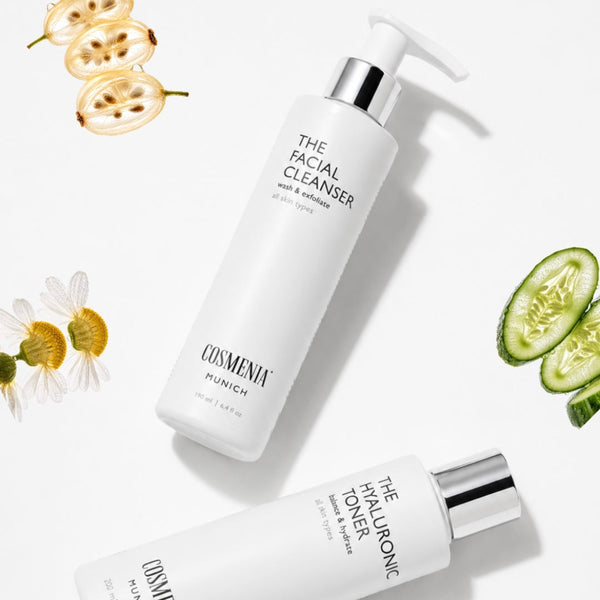
The Facial Cleanser with gentle AHA fruit acids is suitable as the second cleansing step, as it removes residues and excess sebum without putting much strain on the skin barrier. If you only need one mild cleansing step, you can also use it as your sole cleanser.
Step 3: replenish moisture straight away
After every cleanse – single or double – moisture should follow promptly. The Hyaluronic Toner with hyaluronic acid and chamomile compensates for the moisture lost during cleansing and soothes irritated skin. For a complete start, the Cleanse & Balance Set brings cleansing and moisture balance together in one matched routine.
Frequently asked questions about double cleansing
Do I have to double cleanse every evening?
No. Without make-up or sunscreen, a single mild cleansing step is usually enough. Double cleansing is mainly worth it when there really are oil-soluble residues on your skin from the day.
Does double cleansing always damage the skin barrier?
The concept itself doesn't – it only becomes harmful through overly aggressive products, too frequent use or the wrong technique, such as hot water and vigorous rubbing.
Does double cleansing make sense in the morning too?
Usually not. In the morning, there are generally no make-up or sunscreen residues on the skin, so a single mild cleansing step is enough.
Conclusion
Double cleansing is neither useful across the board nor unnecessary hype, but a situational method: helpful with make-up, mineral sunscreen or oily skin, superfluous and potentially stressful for dry or sensitive skin without a corresponding cleansing load. If you want to try the method, use mild products and a gentle technique – and when in doubt, double cleanse once too little rather than too often. The Cleanse & Balance Set provides a skin-friendly basis of cleansing and moisture balance.
Want to see more from COSMENIA in your Google search results? Add us as a preferred source.


Comments