
Vitamin C in Natural Cosmetics: Stability, Effects and Correct Use

 The short answer
Vitamin C (ascorbic acid) protects the skin from oxidative stress as an antioxidant, stimulates collagen formation and inhibits the formation of dark spots. Clinically effective are mainly 10–20% pure L-ascorbic acid at a low pH. However, the molecule is very unstable, which is why more stable derivatives or plant-based sources of vitamin C are often the more practical choice in natural cosmetics.
What vitamin C really does in skincare
Vitamin C is one of the best-researched ingredients in skincare of all. Three mechanisms are well documented: first, as an antioxidant, ascorbic acid neutralises free radicals generated by UV radiation and environmental pollution. Second, it is a necessary cofactor for enzymes that stabilise collagen – without vitamin C, the skin simply produces less resilient collagen. Third, vitamin C inhibits tyrosinase, a key enzyme in melanin production, giving it a brightening effect on dark spots and uneven skin tone.
Important for expectations: vitamin C is not a sunscreen and doesn't replace a UV filter. It complements the skin's antioxidant defences and can ease UV-induced cell stress, but it doesn't make a mineral filter superfluous.
The stability problem: why pure ascorbic acid is so difficult
L-ascorbic acid is considered the gold standard by experts because most clinical studies use exactly this pure form – usually at concentrations of 10 to 20 percent and at a pH below 3.5, as the molecule only penetrates the skin barrier in its uncharged, acidic form. Below around 10 percent, the effect is hardly measurable.
The problem: pure ascorbic acid oxidises very quickly on contact with air, light and heat and turns yellowish-brown – a visible sign that the ingredient has already lost part of its efficacy. Formulations therefore need airtight, opaque packaging and are often still only stable for a short time. Newer formulation approaches work with special carrier systems or complexing agents to reduce the rate of degradation, but are not yet widely established.
Vitamin C derivatives as an alternative
To get around the stability problem, derivatives are often used: magnesium ascorbyl phosphate and ethyl ascorbic acid are considered much more stable and skin-friendly, while ascorbyl tetraisopalmitate is also oil-soluble and suitable for oil formulations. The catch: derivatives first have to be converted enzymatically by the skin into active ascorbic acid, and how efficiently this happens varies from person to person and is less well researched overall than with the pure acid. Studies from recent years on ethyl ascorbic acid do show measurable effects on skin elasticity and pigmentation, but mostly in manufacturer studies with small numbers of participants.
Vitamin C in certified natural cosmetics: a critical assessment
For certified natural cosmetics, pure, synthetically produced L-ascorbic acid in its highly concentrated, low-pH form is only of limited practicality – not because it is banned, but because it is difficult to formulate stably and in a skin-friendly way without resorting to synthetic stabilisers, which many certifications such as COSMOS or NATRUE restrict. That's why natural cosmetics brands often rely on plant-based sources of vitamin C such as acerola, camu camu or sea buckthorn extract. These provide vitamin C in a natural matrix with other antioxidants such as flavonoids, but in much lower and less standardised concentrations than a pure 15 percent ascorbic acid serum.
This is the point where marketing and science often drift apart: ‘vitamin C boost’ or ‘stabilised vitamin C’ on the label says nothing about the actual concentration or the pH – yet both are decisive for efficacy. If you're looking for a clinically proven effect against dark spots, ask for specific percentages and the formulation pH instead of relying on buzzwords.
How to add vitamin C to your routine correctly
Cleansing as the basis
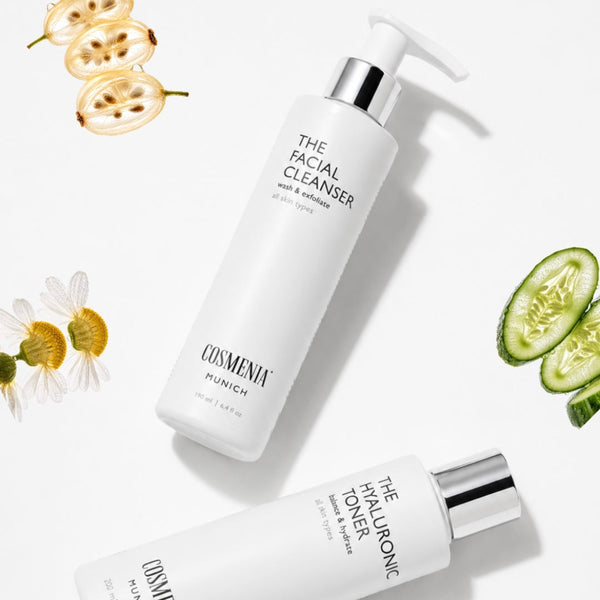
Mild but thorough cleansing ensures that subsequent active ingredients can be absorbed at all. The Facial Cleanser with gentle AHA fruit acids prepares the skin without putting strain on the barrier.
A plant-based source of vitamin C as day care
If you're looking for a gentler but still antioxidant option, The Day Cream with sea buckthorn offers a natural source of vitamin C combined with barrier-strengthening plant lipids – a good basis for sensitive or inexperienced skin.
Don't forget moisture and sun protection
Since vitamin C doesn't replace UV protection, a mineral filter still belongs in every morning routine. The Sun Kiss SPF 30 complements the antioxidant effect of vitamin C with the truly decisive building block against light-induced skin ageing. For extra moisture in between, The Hydrating Serum with Alteromonas ferment extract is a good choice.
Frequently asked questions about vitamin C in skincare
Can I combine vitamin C with niacinamide?
Older studies suspected instability when the two are combined, but newer research shows that both ingredients usually work together without problems in modern formulations. For sensitive skin, using them at different times (morning/evening) can still make sense.
Why does my vitamin C product change colour?
A yellowish to brownish discolouration indicates that the ascorbic acid is oxidising and has lost part of its efficacy. A slight change in colour is normal, but a heavily discoloured product shouldn't be expected to be highly effective any more.
Is vitamin C in natural cosmetics as effective as a 20 percent ascorbic acid serum?
Not necessarily at the same concentration and speed, but plant-based sources of vitamin C deliver the ingredient in a form that is often better tolerated by sensitive skin, complemented by other plant antioxidants.
Conclusion
Vitamin C is one of the few skincare ingredients with truly solid research – provided concentration, pH and stability are right. Pure ascorbic acid is effective but technically demanding to formulate and difficult to reconcile with natural cosmetics standards. If you rely on certified natural cosmetics, see plant-based sources of vitamin C as a gentler but useful complementary alternative rather than a direct substitute for high-dose ascorbic acid. In practice, a routine of mild cleansing, antioxidant day care and consistent sun protection often achieves more than a single high-performance serum – the Hydra Barrier Repair Set is a good place to start.
Want to see more from COSMENIA in your Google search results? Add us as a preferred source.


Comments