
Skin Cycling: The Trend Routine Put to the Scientific Test

 The short answer
Skin cycling is a four-night routine that alternates active ingredients (exfoliation, intensive care) with pure recovery nights so that the skin barrier can regenerate between applications. The basic idea – using active ingredients not every day but alternating them with breaks – is dermatologically well founded, even if the name itself is a social media trend. The principle can easily be adapted for sensitive skin and natural cosmetics.
Where does skin cycling come from?
Skin cycling was popularised by US dermatologist Dr Whitney Bowe and has since become one of the most discussed skincare concepts on social media. The classic structure alternates four nights: night 1 exfoliation with acids, night 2 an intensive active ingredient such as retinol, nights 3 and 4 pure recovery with moisture and barrier-strengthening ingredients. Then the cycle starts again.
The idea behind it isn't new: dermatologists have been recommending for years that retinoids and acids should be introduced gradually rather than used every day, so that the skin can get used to them. Skin cycling packages this principle into an easy-to-remember routine – so the real added value lies less in a new insight than in better communication of a well-known principle.
What makes scientific sense about rotation
Skin isn't a rigid system that can be stressed as often as you like without consequences. After contact with exfoliants or other active ingredients, the skin barrier needs time to rebuild its top protective layer. If it is challenged again every night instead, chronic, low-level irritation can develop that does more harm than good in the long term: the barrier loses resilience, active ingredients are tolerated less well, and redness, dryness or a vicious circle of irritation and renewed sensitivity can follow.
Recovery nights with pure moisturising care counteract this by giving the skin the time it needs to regenerate. This matches basic findings on skin barrier physiology and is a sensible principle regardless of the trend name.
A critical look: where the trend exaggerates
What's often missing in the current discussion: robust clinical studies that specifically investigate the four-night scheme as a whole. Most available sources are expert opinions and experience reports, not controlled comparative studies against other rotation schemes. The individual building blocks – gradual exfoliation, rest days with retinoids, a focus on barrier protection – are well documented, but the rigid four-day grid itself is more of a practical communication model than an evidence-based formula.
On top of that, a fixed scheme doesn't suit every skin type. Very sensitive skin often needs more than two recovery days, while more resilient skin can cope with more frequent active nights. If you cycle strictly by the calendar instead of paying attention to redness, tightness or irritation, you're giving away exactly the advantage the principle is supposed to offer: stress management adapted to your skin rather than a rigid ritual.
Skin cycling with natural cosmetics
Night 1: gentle exfoliation
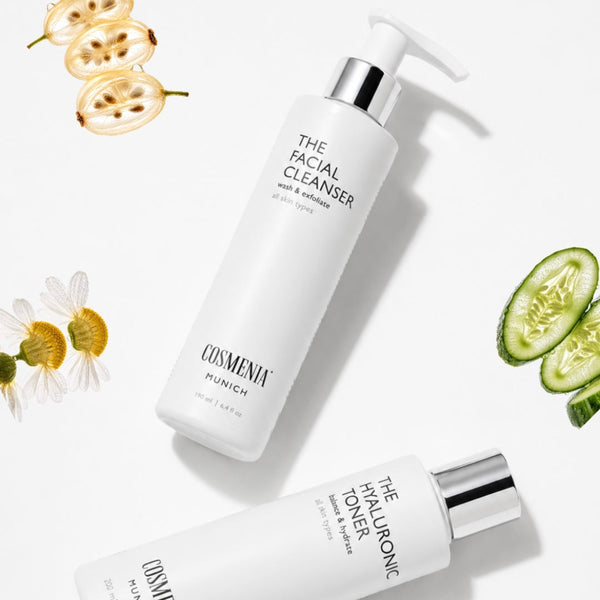
The Facial Cleanser with mild AHA fruit acids takes over the exfoliation night without overwhelming the skin with high-dose acids – a gentler start than aggressive exfoliating acids, especially for skin used to natural cosmetics.
Night 2: intensive but barrier-friendly care
Instead of a high-dose retinoid, which is hardly found in certified natural cosmetics anyway, The Hydrating Serum with Alteromonas ferment extract takes over the active night: it supports regeneration without the irritation potential of classic retinoids.
Nights 3 and 4: recovery and building moisture
The Hyaluronic Toner with hyaluronic acid and chamomile restores moisture and soothes, while The Beauty Sleep Cream & Mask with shea butter richly supports the barrier during the recovery nights and gives it time to regenerate.
Frequently asked questions about skin cycling
Do I have to stick strictly to the four-night order?
No. The order is a practical framework, not a rigid law. More important than the exact scheme is paying attention to how your own skin reacts and extending recovery phases if necessary.
Is skin cycling also suitable for sensitive skin?
Sensitive skin in particular can benefit from the structure, but should start with the mildest available active ingredients and extend rather than shorten the recovery nights.
Does skin cycling replace individual skincare advice?
No. The scheme is a general framework; for persistent irritation or skin problems, an individual assessment remains more useful than a one-size-fits-all rotation model.
Conclusion
Skin cycling isn't a scientific breakthrough, but the catchy packaging of a well-known dermatological principle: active ingredients need breaks so that the skin barrier can recover. As a rough guide, the principle makes sense; as a rigid calendar scheme, it should take second place to your skin's individual reaction. With a mild AHA cleanser, a barrier-friendly active serum and enough recovery nights with rich moisturising care such as The Beauty Sleep Cream & Mask, the concept can also be put into practice well with certified natural cosmetics.
Want to see more from COSMENIA in your Google search results? Add us as a preferred source.


Comments