
Copper Peptides for Wrinkles: What GHK Cu Can Really Do

Note: Image partly or fully created with AI.
The short answer
Copper peptides (GHK Cu) are marketed as an ingredient against wrinkles, but solid proof is still missing. The impressive figures come almost exclusively from cell cultures, animal studies and small, partly industry linked trials. A 2026 systematic review found just two randomised controlled trials in humans for aesthetic use.
Copper peptides at a glance
- INCI: Copper Tripeptide-1, produced synthetically in the lab
- Typical concentration: around 0.01 to 0.1 percent in serums and creams
- Well documented: effects on collagen formation and wound healing in cell cultures and animal models
- Barely documented: visible wrinkle reduction from regular creams and serums in everyday use
- Biggest weakness: few, small human studies, often involving manufacturers
- Natural cosmetics: as a synthetic peptide not compatible with COSMOS standards
What are copper peptides?
Copper peptides are short protein fragments bound to a copper ion. The best known is GHK Cu, a compound of the three amino acids glycine, histidine and lysine. Our body produces GHK itself, it is found in blood plasma, for example, and its levels decline with age. This very story is what makes the ingredient so attractive for marketing.
The GHK Cu in serums and creams, however, does not come from the body but is synthesised in the lab. Why this is a fundamental problem for certified natural cosmetics is explained in our article Copper peptides in skincare. For an overview of all peptide types, read Peptides in cosmetics: which ones exist and do they really work?
Why are copper peptides supposed to help against wrinkles?
The idea sounds logical: GHK Cu is considered a signal peptide. It is meant to tell the skin's connective tissue cells, the fibroblasts, that repair is needed. In the lab, this looked as follows:
- Collagen and elastin: in cell cultures, GHK Cu stimulates the formation of collagen, elastin and glycosaminoglycans
- Slowing breakdown: it influences enzymes that break down collagen (metalloproteinases) as well as their natural counterparts
- Wound healing: in animal studies, wounds healed faster with GHK Cu
- Gene activity: gene analyses show that GHK alters the activity of thousands of genes, which is often interpreted as proof of rejuvenation
The catch: a petri dish is not facial skin. Whether the peptide from a cream actually reaches the fibroblasts in the dermis in sufficient amounts has hardly been studied independently. GHK Cu is highly water loving and passes the skin barrier only poorly.
Critical review: what the studies on copper peptides for wrinkles really show
We looked at the studies most frequently cited in advertising. None of them is wrong, but none of them is representative.
The thigh study (1998)
It is often claimed that GHK Cu increased collagen production in 70 percent of women, more often than vitamin C or retinoic acid. Behind this is a study with a total of 20 people who applied different creams to their thighs over a few weeks. Results were measured by skin biopsy, not on facial wrinkles.
The facial study with nanocarriers (2016)
The most cited wrinkle study: 40 women aged 40 to 65, eight weeks, double blind. Wrinkle volume decreased by 55.8 percent compared with the serum without the active ingredient. Sounds strong, but there are two catches. The GHK Cu was packed into special lipid nanocarriers designed to make skin penetration possible in the first place. And the test serum was provided by a cosmetics company. The result cannot be transferred to a regular copper peptide serum.
The face and eye cream studies
Also widely cited: studies with 71 and 41 women over twelve weeks in which GHK Cu creams are said to have improved fine lines, firmness and skin density. These data were mainly presented at scientific conferences in the early 2000s. In our research, we could not find a complete, peer reviewed publication with all measurement data.
Who summarises the studies
Many of the reviews that shops and influencers rely on were written by Loren Pickart. He discovered the peptide in the 1970s and sells copper peptide products himself. This does not make his work worthless, but it is a conflict of interest worth knowing about.
What independent reviews say
In 2025, a research team noted in the journal BioImpacts that despite widespread marketing there are surprisingly few clinical studies, and data on skin permeability are lacking too. A systematic review in the Aesthetic Surgery Journal from 2026 evaluated 20 studies: 18 were preclinical, only 2 were randomised controlled trials in humans. The authors' conclusion: biologically plausible, but larger, properly controlled studies are needed.
Does that mean copper peptides do not work? No. The honest answer is: plausible, but not proven. Anyone promising more is mainly selling a good story.
What has more proven effect against wrinkles
The best documented measures are less spectacular. Daily sun protection slows light induced skin ageing, which is responsible for a large share of visible wrinkles. Retinoids are also well researched, read more in our article Retinal vs. Retinol. And an intact, well hydrated skin barrier makes fine dryness lines look less visible right away. That is exactly where our routine comes in.
The routine for a strong skin barrier instead of hype
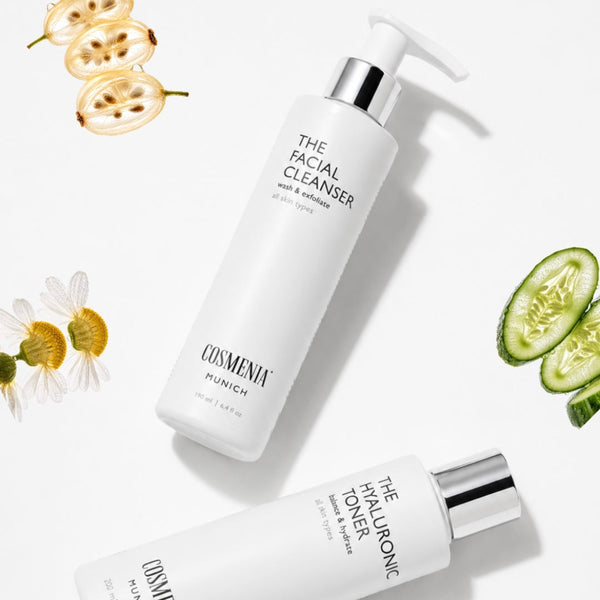
Step 1: Cleanse gently with The Facial Cleanser
The Facial Cleanser cleanses thoroughly with lavender flower water, white currant extract and glycolipids without drying out the skin. The foundation for everything that follows to be absorbed well.
Step 2: Boost hydration with The Hydrating Serum
The Hydrating Serum combines hyaluronic acid with ceramides and Alteromonas ferment extract, a fermented active ingredient from the sea. Instead of a synthetic signal substance, the serum relies on hydration and barrier care that visibly smooth dryness related fine lines.
Step 3: Protect with The Day Cream
The Day Cream with jojoba oil, blueberry extract and ceramides forms a light protective film over the skin and keeps moisture where it belongs. During the day, add a sunscreen such as The Sun Kiss SPF 30.
You can get all three steps together in the Hydra Barrier Repair Set at a special price.
Frequently asked questions about copper peptides
Do copper peptides work against wrinkles?
Plausible, but not proven. The few human studies are small, short and partly industry linked, and the strongest effects come from lab and animal studies.
How long does it take to see results with copper peptides?
Manufacturers usually state 8 to 12 weeks. These time frames come from the small studies mentioned above and have not been independently confirmed.
Can copper peptides be combined with vitamin C or acids?
This is often advised against, as acidic formulations and vitamin C can destabilise the copper complex. If you use copper peptides, it is better to apply them at a different time of day.
Are copper peptides better than retinol?
There is no solid evidence for this. Retinoids are far better researched against photoageing than GHK Cu.
Are there copper peptides in certified natural cosmetics?
Hardly, because the GHK Cu used in cosmetics is produced synthetically and is not compatible with COSMOS criteria. That is why Cosmenia relies on fermented and plant based active ingredients.
Conclusion
Copper peptides for wrinkles are a textbook example of how exciting lab research turns into a marketing promise. GHK Cu is biologically interesting, but the human studies are too small, too short and too often industry linked to prove visible wrinkle reduction from creams and serums. If you want your skin to look smoother and plumper, sun protection, hydration and a strong skin barrier will serve you better.
Discover the matching routine in the Hydra Barrier Repair Set by Cosmenia.
Sources
- Mortazavi SM, Mohammadi Vadoud SA, Moghimi HR: Topically applied GHK as an anti-wrinkle peptide: Advantages, problems and prospective. BioImpacts 2025;15:30071. DOI: 10.34172/bi.30071
- Mokhtar J et al.: The Regenerative Potential of GHK-Cu in Aesthetic Medicine. Aesthetic Surgery Journal 2026. DOI: 10.1093/asj/sjag169
- Badenhorst T et al.: Effects of GHK-Cu on MMP and TIMP Expression, Collagen and Elastin Production, and Facial Wrinkle Parameters. Journal of Aging Science 2016;4(3):166. DOI: 10.4172/2329-8847.1000166
- Pickart L, Margolina A: Regenerative and Protective Actions of the GHK-Cu Peptide in the Light of the New Gene Data. International Journal of Molecular Sciences 2018;19(7):1987. DOI: 10.3390/ijms19071987
Last updated: November 2026
Want to see more from COSMENIA in your Google search results? Add us as a preferred source.


Comments