
Sun protection when skiing: is mineral SPF 30 really enough in the snow?

In short
Sun protection when skiing matters because UV radiation increases with altitude and snow reflects it back onto your skin. Experts recommend at least SPF 30 with broad-spectrum protection, applied generously and renewed regularly. Mineral filters such as zinc oxide are a plausible option.
Read more in our anti-ageing & pigmentation guide.
Sun protection when skiing at a glance
- Altitude: As a rule of thumb, UV radiation rises by about 10% per 1,000 metres of altitude; alpine measurements show higher values for UV-B in some cases (around 19% per 1,000 m)
- Snow: Fresh snow reflects UV radiation far more strongly than grass or rock; modelling puts effective reflectance at roughly 0.77 for fresh snow and 0.41 for older snow
- Well supported: Skiers are exposed to high UV doses at altitude, and experts recommend at least SPF 30 with broad-spectrum protection
- Partly supported: Physical filters may reduce redness and tanning on the face, but direct comparative studies on skiing are lacking
- Not supported: That mineral filters protect better than chemical ones in snow; amount and reapplication are what count
- Use: Protect face, ears, neck and lips, reapply after about two hours, and add goggles and a hat
What is sun protection when skiing?
Sun protection when skiing is the combination of sunscreen, clothing, goggles and habits that protects skin and eyes from UV radiation in the mountains.
The tricky part: cold does not protect you. The warmth you feel comes mainly from infrared radiation, while sunburn comes from UV radiation. The two have little to do with each other.
What happens to UV radiation in the snow
Altitude: more UV with every metre
The higher you go, the thinner the atmosphere and the less UV it filters out. A rule of thumb is about 10% more UV per 1,000 metres. Comparative measurements between Innsbruck (577 m) and the Jungfraujoch (3,576 m) found around 19% per 1,000 m for UV-B. At 3,500 metres in the Italian Alps, a UV index of 12.3 was recorded on one July day (Casale et al., 2015). In January the values are lower, but the principle holds.
Snow: radiation from above and below
Snow reflects part of the UV radiation. How much depends on its condition: modelling gives effective reflectance of about 0.77 for fresh snow and about 0.41 for older snow. So radiation also reaches your chin, nose and ears from below, where a cap does not help.
Clouds: no free pass
A study at 32 North American ski areas with 3,937 respondents explicitly recommends sunscreen on cloudy days too, because UV exposure can still be high and conditions change quickly (Andersen et al., 2010).
Critical view: what the research really shows
The data on UV exposure while skiing is fairly clear; the data on specific filter types is much thinner.
Well supported: A measurement study on skiers (Rigel et al., 2003) found a total UV-B exposure of 0.5 to 7.6 minimal erythema doses (for skin type II); 10% of participants received more than one dose per hour at peak times. The authors recommend broad-spectrum sunscreen of SPF 30. In mountain guides, the median daily dose was about six times the occupational UV exposure limit (Moehrle et al., 2003), although that is a group with year-round exposure.
Partly supported: A review of outdoor sports describes an increased risk of squamous cell carcinoma for skiing and names sweating as a possible factor for higher light sensitivity (Moehrle, 2008). These are associations from observational data, not a statement about a single ski holiday.
Mineral vs. chemical: In the Plateau Rosà study, the authors concluded that physical sunscreens leaving a white cast might have reduced skin colour change. That is a cautious assumption from a small field study, not proof that mineral protects better in snow. Amount and reapplication matter more, as we explain in How to apply sunscreen properly. More on filter types: Mineral vs. chemical sunscreen.
Eyes: UV can also damage the cornea (snow blindness, keratitis). No cream helps here, but goggles with UV protection do.
How to protect yourself properly when skiing
Before the first lift
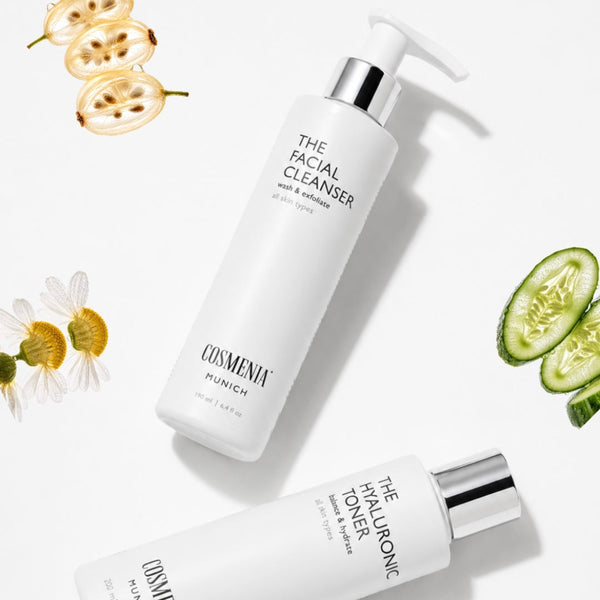
Apply sun protection before you set off, not at the gondola. As the last step of your morning routine, The Sun Kiss SPF 30 is a good fit: it contains zinc oxide as a mineral filter, offers UVA/UVB broad-spectrum protection, is formulated without nanoparticles and is certified Ecocert COSMOS Natural. Underneath you can use a moisturiser such as The Hydrating Serum, because cold mountain air is dry.
Reapplying and problem areas
Sweat, scarves and wiping rub sunscreen off. Reapply about every two hours, for example at lunch. Don't forget your ears, nape, hairline and the skin under your chin. For your lips you need a separate balm with SPF, as face cream wears off there quickly.
After the ski day
Cleanse gently and give your skin moisture back. If you have redness or tightness, skip peelings for now.
Our recommendation
For ski holidays and trips, The Travel Routine is a good match: the set contains the Beauty Bag, The Facial Cleanser, The Hydrating Serum and The Sun Kiss SPF 30. If you already have a routine, The Sun Kiss SPF 30 alone is enough.
Frequently asked questions about sun protection when skiing
Which SPF do I need for skiing?
At least SPF 30 with UVA protection, as recommended in a measurement study on skiers. The right amount matters more than the number.
Can you get sunburnt skiing on a cloudy day?
Yes. UV exposure can be high even with cloud, and snow reflects radiation. A study at ski areas therefore recommends sunscreen on cloudy days too.
Is mineral sunscreen better for winter?
That is not proven. Mineral filters such as zinc oxide are a plausible choice, but studies do not show an advantage over chemical filters in snow.
How often should I reapply on a ski holiday?
About every two hours, and after heavy sweating or wiping.
Conclusion
Sun protection when skiing is not optional: altitude and snow increase UV exposure, and cold air makes it less noticeable. Mineral SPF 30 such as The Sun Kiss SPF 30 is a well-suited basis, but it replaces neither reapplication nor goggles and a hat.
Sources
- Rigel EG et al.: Ultraviolet radiation in alpine skiing. Arch Dermatol 2003. DOI: 10.1001/archderm.139.1.60
- Andersen PA et al.: Environmental cues to UV radiation and personal sun protection in outdoor winter recreation. Arch Dermatol 2010. DOI: 10.1001/archdermatol.2010.327
- Casale GR et al.: Extreme UV index and solar exposures at Plateau Rosà. Sci Total Environ 2015. DOI: 10.1016/j.scitotenv.2015.01.049
- Moehrle M: Outdoor sports and skin cancer. Clin Dermatol 2008. DOI: 10.1016/j.clindermatol.2007.10.001
Updated: November 2026
Want to see more from COSMENIA in your Google search results? Add us as a preferred source.


Comments