
Zinc PCA vs. Niacinamide: Which Works Better Against Oily Shine?

Note: Image partly or fully created with AI.
In short
Neither zinc PCA nor niacinamide is universally "better" against oily shine. Niacinamide has controlled studies showing reduced sebum production. Zinc PCA has thinner data and is regarded as gently balancing. Which one suits you depends on tolerance and skin type.
More on blackheads, shine and pores in our Blemish-Prone Skin Guide.
Zinc PCA and niacinamide at a glance
- Niacinamide: a form of vitamin B3 (INCI: Niacinamide), usually used at 2–5%.
- Zinc PCA: the zinc salt of pyrrolidone carboxylic acid, a component of the skin's natural moisturising factor.
- Well supported: niacinamide can reduce sebum production and improve the look of pores (small to mid-sized studies).
- Partly supported: zinc PCA affects sebum-related processes in the lab; clinical data are limited.
- Not supported: that either ingredient permanently "shrinks" pores.
- Use: morning and/or evening after cleansing; expect results after several weeks at the earliest.
Where does oily shine come from?
Oily shine occurs when the sebaceous glands produce more sebum than the skin surface can absorb. It is typical in the T-zone with combination skin. Hormones, genetics, warmth and care mistakes all play a part. Stripping the skin with harsh products can also make things worse. Why skin feels tight after washing is explained in our article on tight skin after cleansing.
Niacinamide: good evidence, but no miracle
Niacinamide is a well-studied ingredient. In a study by Draelos et al. (2006), a cream with 2% niacinamide measurably lowered facial sebum production over several weeks. Other work reports improvements in skin appearance and barrier function. Effects are moderate, and studies are often small and sometimes manufacturer-funded. We covered it in detail in Niacinamide for blemish-prone skin. Higher concentrations are not automatically better and can cause redness and tingling on sensitive skin.
Zinc PCA: gently balancing, less data
Zinc PCA is a zinc salt used in cosmetics to balance blemish-prone skin. In the lab, zinc is linked to inhibition of sebum-related processes and antibacterial effects. Good independent clinical studies on zinc PCA in skincare products are rare, however. Read more in Zinc PCA for blemish-prone skin. Lack of large studies does not mean it does not work, but claims such as "reliably regulates sebum" are not backed up.
The comparison: which ingredient when?
If the evidence matters most to you
Niacinamide has the broader evidence. It is worth trying for oily shine and larger-looking pores if your skin tolerates it.
If your skin reacts easily
Zinc PCA is usually well tolerated at typical concentrations and fits into a light, oil-free formula. For sensitive skin it can be the more relaxed choice.
And combining them?
The two complement each other in many formulas. More important than the ingredient is the overall routine: gentle cleansing, enough moisture, sun protection.
In practice: tackling oily shine in your routine
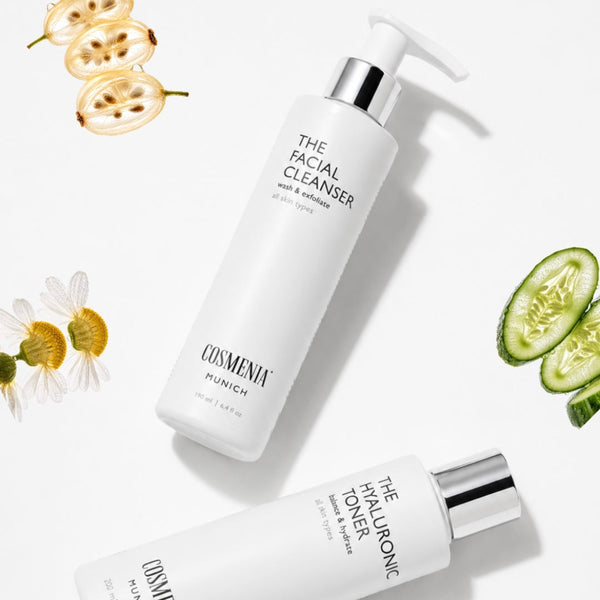
Choose a gentle cleanser that removes excess sebum without drying, such as The Facial Cleanser with lactic acid. Then an oil-free gel such as The Glowy Gel provides moisture with aloe vera, plant-based hyaluronic acid and zinc PCA. Note: Cosmenia uses zinc PCA in this gel; it does not contain niacinamide. Moisture is not a contradiction with oily shine but often part of the solution.
Our recommendation
For combination skin prone to shine we put together the Clear Skin Set: oil-free cleansing, a soothing toner and a balancing gel in three matched steps. As a single product, The Glowy Gel works as a light moisturiser.
Frequently asked questions about zinc PCA and niacinamide
Is zinc PCA better than niacinamide against oily shine?
Not proven. Niacinamide is better studied; zinc PCA is often perceived as gentler. Which suits you is individual.
Can I combine zinc PCA and niacinamide?
Yes, the combination is common in products and considered well tolerated. With sensitive skin, start with one ingredient.
How long until oily shine improves?
Expect several weeks of consistent use. Sebum production does not change overnight.
Does niacinamide shrink pores?
Pores cannot be permanently shrunk. Niacinamide can make them look less noticeable, mainly through less sebum.
Do I need a moisturiser at all with oily shine?
Yes. Without moisture, skin may produce more sebum. An oil-free gel is usually the right texture.
Conclusion
Against oily shine, niacinamide has the better evidence, while zinc PCA stands out as a gentle balancer. Neither replaces a coherent routine. If you want to balance combination skin, start with the Clear Skin Set.
Sources
- Draelos Z. D. et al.: The effect of 2% niacinamide on facial sebum production. Journal of Cosmetic and Laser Therapy 8(2), 2006, pp. 96–101
- Regional and seasonal variations in facial sebum secretions: a proposal for the definition of combination skin type (PubMed 15998330)
As of: November 2026
Want to see more from COSMENIA in your Google search results? Add us as a preferred source.


Comments