
Gua Sha & Face Yoga: What Facial Massage Really Does – and Where the Hype Begins

Note: image partly or fully created with AI.
The short answer
Gua sha and face yoga can reduce puffiness in the short term and stimulate circulation – the skin looks fresher afterwards. Lasting ‘jawline sculpting’ or wrinkle-free skin is not proven, and the few studies are small. As a relaxing ritual combined with good skincare, however, both methods certainly make sense.
What is gua sha, and what is face yoga?
Gua sha comes from traditional Chinese medicine. Originally, it involved scraping the back and body with firm pressure. The facial version is much gentler: a flat stone made of jade, rose quartz or stainless steel is drawn over the face and neck with light pressure.
Face yoga is a workout for the facial muscles: targeted exercises in which the cheek, forehead and mouth muscles are tensed and stretched – usually without any tools.
What the studies show
Gua sha: the ‘fourfold circulation’
The most frequently cited figure comes from a 2007 pilot study: in eleven participants, microcirculation rose to about four times its level in the first few minutes after gua sha and remained elevated for around 25 minutes. The catch: it was the back that was treated, with firm pressure and without a control group. This can't be transferred directly to gentle use on the face.
Face-specific data is scarce. A randomised study from 2025 compared facial rollers and gua sha over eight weeks and found measurable changes in facial contour and skin elasticity – but also on a small scale.
Face yoga: a small but well-known study
A Northwestern University study published in JAMA Dermatology in 2018 had middle-aged women do facial exercises regularly for 20 weeks. Afterwards, their cheeks looked somewhat fuller and the participants were rated as looking younger. But only 16 women completed the study, and there was no control group.
A critical look: what's realistic
- De-puffing: Morning puffiness around the eyes and cheeks can be reduced in the short term with gentle massage. That's displaced fluid, not a change in shape.
- Fresher complexion: Stimulated circulation makes the skin rosier – for a few minutes to hours.
- No lasting sculpting: No stone changes bones or fat pads. Before-and-after pictures on social media usually only show the de-puffing effect.
- No ‘detox’: Detox is a marketing term. The lymph transports fluid, not ‘toxins’ that could be massaged out.
The relaxation effect is often underestimated: if you consciously take ten minutes for your face in the evening, you release tension in your jaw and forehead – and that alone feels good.
How to use gua sha gently on the skin
1. Clean skin
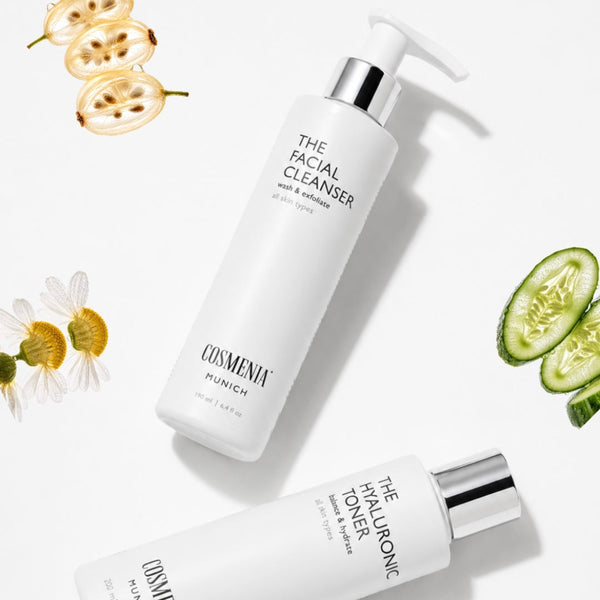
Start with thoroughly cleansed skin, for example using The Facial Cleanser. Clean the stone beforehand too.
2. Slip-giving skincare
The stone should never drag over dry skin, otherwise irritation and redness can result. A rich cream such as The Beauty Sleep Cream & Mask provides enough slip, while The Hydrating Serum underneath adds extra moisture.
3. Gentle pressure, from the inside out
Place the stone flat and stroke from the centre of the face outwards and from the chin towards the ear, and on the neck from top to bottom. Light pressure is enough – bruises or lasting redness are a sign of too much.
4. When better not to
Don't massage over inflamed spots, open areas, freshly treated skin or during acute rosacea flare-ups.
Frequently asked questions about gua sha and face yoga
How often should I use gua sha?
Two to three times a week is enough, or even daily if used very gently. Pay attention to how your skin reacts.
Does gua sha improve the absorption of skincare products?
There's no robust evidence for this. The massage spreads the product but doesn't channel it deeper into the skin.
Is jade better than stainless steel?
The material makes little difference to the effect. What matters are smooth edges and good cleaning.
Can face yoga make wrinkles worse?
Exercises involving strong frowning or squinting can tend to accentuate expression lines. Choose exercises that tense the muscles without strongly folding the skin.
Conclusion
Gua sha and face yoga aren't alternatives to a facelift, but they are lovely rituals with a real short-term effect: less puffiness, a fresher complexion, more relaxation. A good skincare foundation is what matters – for example The Glow Routine for a radiant complexion that convinces even without a stone.
Want to see more from COSMENIA in your Google search results? Add us as a preferred source.


Comments