
Skin Fasting: What the Trend Can Do – and When a Minimal Routine Is Better

Note: image partly or fully created with AI.
The short answer
Skin fasting means deliberately cutting your skincare down to the essentials for a while. It makes most sense for relieving over-treated or irritated skin and for finding out which products you really need. Experts do not recommend going completely without care or sunscreen.
Skin fasting at a glance
- What: Temporarily reducing your routine to a few basics, usually cleanser, moisturiser and sunscreen
- Goal: Relieve over-treated skin and identify intolerances
- Well reasoned: Fewer products mean fewer potential irritants and fewer interactions between actives
- Not proven: That skin “repairs” or “detoxes” itself during a complete break – there are no controlled studies on this
- Not suitable: For very dry skin, atopic dermatitis, rosacea or ongoing medical treatment without consulting a doctor
- Never skip: Sunscreen
What is skin fasting?
Skin fasting is a skincare trend in which the routine is drastically reduced for a few days or weeks. The term is borrowed from therapeutic fasting: the skin is meant to get a break from lots of active ingredients. Cosmopolitan has also picked up on the trend, showing that modern skincare is more about smart reduction than ever more products.
An important distinction: skin fasting has nothing to do with dietary fasting. Studies on fasting diets and skin look at what nutrition does – not at what happens when you leave out creams.
Why less care sometimes achieves more
Too many actives stress the barrier
Many routines combine acids, retinoids, vitamin C and other actives. Useful on their own, together they can overwhelm the skin barrier. Typical signs are tightness, stinging when applying cream and redness. More on this in our article Skin stings when applying cream.
Intolerances become visible
When you only use a few products, it is easier to see which one is causing problems. Reintroducing products step by step quickly shows what your skin really needs.
Fewer steps, more consistency
A short routine is more likely to be followed every day – and in skincare, regularity often matters more than the number of products.
A critical look: what the research really shows
There are no controlled studies on skin fasting as a skincare break. The idea that skin can “regulate itself” without care sounds plausible but is not proven. For dry skin, a complete break can even weaken the barrier further because lipids and moisture are missing. Dermatologists therefore usually recommend not a total break but a basic routine of cleanser, moisturiser and sunscreen.
The underlying idea, however, is well reasoned: fewer products mean fewer possible irritants. The related trend skin flooding takes the opposite approach, relying on many layers of hydration.
How to do skin fasting right
Step 1: Reduce to three products
In the morning: gentle cleanser, moisturiser and sunscreen. In the evening: cleanse and moisturise. A light, barrier-strengthening day cream such as The Day Cream with plant lipids and plant-based hyaluronic acid makes a good base; for sun protection, for example The Sun Kiss SPF 30.
Step 2: Observe for two to four weeks
The stratum corneum renews itself roughly every four weeks. After this time you can judge well whether your skin has calmed down.
Step 3: Reintroduce selectively
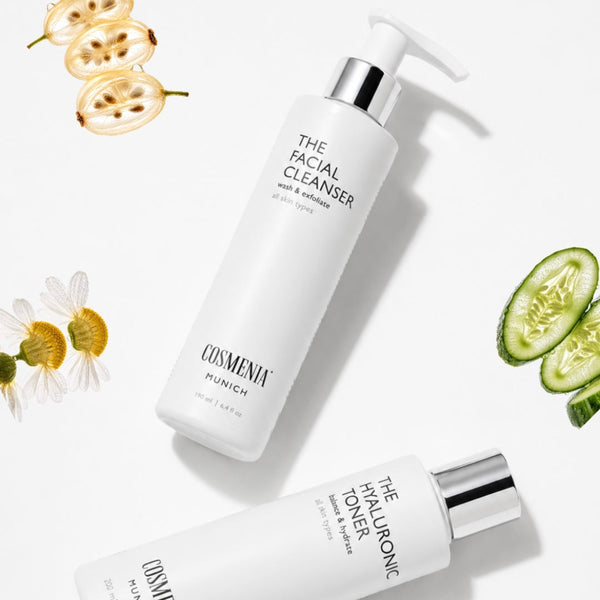
If something is missing, add at most one product every one to two weeks, such as a serum. That way it stays clear what helps and what doesn't. A ready-made minimal routine is the Cleanse & Balance Set with cleanser and toner.
Frequently asked questions about skin fasting
How long should you do skin fasting?
Two to four weeks is a sensible period to observe how your skin reacts. After that, individual products can be added back gradually.
Can I skip sunscreen while skin fasting?
No. Sunscreen is one of the few products you need every day, even in a minimal routine.
Is skin fasting suitable for dry skin?
Only in its gentle form. Dry skin still needs a moisturiser, otherwise the barrier can get worse.
Does skin fasting help with breakouts?
If breakouts are caused by too many or unsuitable products, a reduced routine can help. For hormonal or inflammatory breakouts, it is usually not enough.
What is the difference between skin fasting and skinimalism?
Skin fasting is a temporary break; skinimalism is a permanently reduced routine. Both rely on fewer, more targeted products.
Conclusion
Skin fasting is not about giving up skincare but about returning to the essentials. As a temporary reduction to cleansing, moisture and sun protection, it can relieve over-treated skin and show what it really needs. A stable base for this is Cosmenia's The Day Cream.

Sources
- Cosmopolitan: Skin Fasting für reine Haut, cosmopolitan.de
- mindbodygreen: So “Skin Fasting” Is A Thing, But Is It Safe? Expert interview with a dermatologist, February 2025
- The Effects of a Fasting Mimicking Diet on Skin Hydration, Skin Texture, and Skin Assessment: A Randomized Controlled Trial. Journal of Clinical Medicine, 2023 (to distinguish from dietary fasting)
As of: October 2026
Want to see more from COSMENIA in your Google search results? Add us as a preferred source.


Comments