
Sensitive skin in winter: what really soothes red, irritated skin?

Note: Image partly or entirely created with AI.
The short answer
Sensitive skin in winter reacts more strongly because cold and dry central-heating air weaken the skin barrier. What may help: gentle cleansing, consistent moisturising, few products and avoiding unnecessary irritants. Persistent redness should be assessed by a dermatologist.
Sensitive skin in winter at a glance
- Triggers: cold, low humidity, heating air, wind and frequent switching between indoors and outdoors
- Well supported: low humidity and low temperatures reduce skin barrier function (review article, 2016)
- Partly supported: sensitive skin as a disorder of the fine skin nerves; this is a hypothesis from a narrative review (2022)
- Not supported: that a single ingredient "cures" redness; skincare can support the skin but does not replace a diagnosis
- Use: cleanse gently, add moisture and lipids, test new products one at a time
What is sensitive skin, exactly?
Sensitive skin is not a fixed diagnosis but a description: the skin reacts to triggers such as cold, heat or skincare products with burning, tightness, tingling, itching or redness, without a clear clinical finding. A 2022 review puts the lifetime prevalence at around 50% based on self-reports. Self-reported means it tells us more about how many people experience themselves as sensitive than how many have a measurable condition.
As a beautician, I see the same thing every winter: clients arrive with skin that "suddenly can't tolerate anything". Usually it is not the skin that has changed, but its surroundings.
Why does skin react more strongly in winter?
Cold and dry air weaken the barrier
The review by Engebretsen et al. (JEADV, 2016) evaluates studies on climate and skin. Their conclusion: low humidity and low temperatures reduce barrier function and make the skin more vulnerable to mechanical stress. The skin also appears to become more reactive to irritants and allergens. This is an analysis of many studies, mostly looking at eczema. It can only be applied with caution to skin without a condition that simply reacts sensitively.
Redness: a vascular response, not just the barrier
When you come in from the cold into a warm room, your blood vessels dilate. With sensitive skin, this becomes visible more quickly. Part of the redness is therefore a normal vascular reaction. If it persists, or burning or pustules appear, rosacea, for example, may be behind it. Skincare cannot clarify that. You can find more on the causes in our article Redness on the face: causes and what really helps.
A hint from health-care data
A Finnish database study (Acta Derm Venereol, 2025) found the most doctor visits for atopic dermatitis in Helsinki from January to March and in November. There was a significant association with low outdoor temperatures, but not with relative humidity. This is an observation, not proof of cause and effect, and it concerns atopic dermatitis, not sensitive skin in general.
Critical assessment: what the studies really show
It is well supported that cold and dry air put strain on the barrier. It is less clear which skincare products measurably soothe sensitive skin. For many ingredients, the data come from small studies, often funded by the manufacturer or carried out in people with skin conditions. The 2022 review also describes that sensitive skin is probably linked to the nerve endings in the skin. That is a hypothesis which skincare cannot simply "repair".
Be sceptical of claims such as "hypoallergenic", "irritant-free" or "cures redness". Under the EU Cosmetics Regulation (Regulation (EC) No 1223/2009), claims must be substantiated, and cosmetics must not cure diseases. "Natural" does not protect against reactions either: plant substances can sensitise. Certification and the absence of synthetic fragrances reduce certain sources of irritation, but do not rule out individual reactions.
The right care for sensitive skin in winter
Cleanse gently, don't overdo it
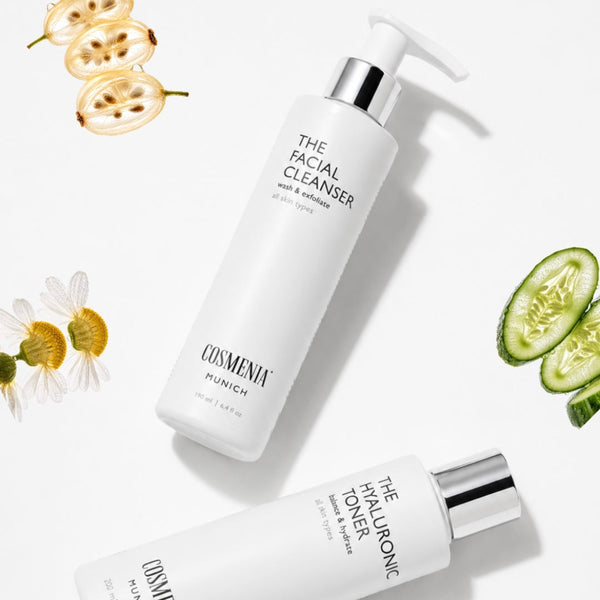
Hot water and overly intensive cleansing strip the skin of additional lipids. Cleanse thoroughly in the evening; in the morning, lukewarm water is often enough. The Facial Cleanser contains mild AHA fruit acids. If your skin is acutely irritated, pause acid-containing products and only return to them once your skin has calmed down. We explain why acids can burden the barrier in AHA fruit acids at home.
Combine moisture and plant lipids
Hyaluronic acid binds water; lipids help keep it in the skin. The Hydrating Serum and The Day Cream contain plant lipids (glycolipids) as well as plant-based hyaluronic acid and are COSMOS Organic certified. We explore the barrier topic further in Strengthening the skin barrier.
Few products, one newcomer at a time
The fewer products you use, the easier it is to find a trigger. Test new products one at a time, on a small area, and wait a few days. During the day, sun protection remains relevant even in winter, for example with The Sun Kiss SPF 30, a mineral sun cream.
For cleansing and moisture together, there is the Cleanse & Balance Set.
Frequently asked questions about sensitive skin in winter
Why does my skin get so red in winter?
Cold and heating air put strain on the barrier, and rapid temperature changes dilate the blood vessels. If redness or burning persists, have it checked by a doctor.
What soothes irritated skin quickly?
Briefly avoid peels, acids and fragrances, cleanse with lukewarm water and use a simple moisturiser. There is no guarantee of a quick effect.
Are natural cosmetics automatically better for sensitive skin?
No. Natural cosmetics avoid certain ingredients, but plant substances can irritate too. Check the ingredient list and test new products one at a time.
Does hyaluronic acid help sensitive skin in winter?
It can give the skin moisture. Combine it with a cream so that the moisture is retained.
When should I see a dermatologist?
If redness lasts for weeks, with burning, scaling, pustules or itching, or if skincare does not improve anything.
Conclusion
Sensitive skin in winter is above all a barrier problem caused by cold and dry air. Gentle cleansing, moisture with plant lipids and a lean routine are a sensible approach. The Hydrating Serum is one example. Anything beyond that should be clarified by a doctor.
Sources
- Engebretsen KA, Johansen JD, Kezic S, Linneberg A, Thyssen JP: The effect of environmental humidity and temperature on skin barrier function and dermatitis. J Eur Acad Dermatol Venereol 2016;30:223–249. DOI: 10.1111/jdv.13301
- Misery L, Bataille A, Talagas M, Le Gall-Ianotto C: Sensitive Skin Syndrome: A Low-Noise Small-Fiber Neuropathy Related to Environmental Factors? Front Pain Res 2022. DOI: 10.3389/fpain.2022.853491
- Räisänen E, Remitz A, Salava A: Seasonal Variation of the Burden of Atopic Dermatitis in Finnish Primary Care. Acta Derm Venereol 2025;105. DOI: 10.2340/actadv.v105.43041
- Regulation (EC) No 1223/2009 on cosmetic products
Last updated: November 2026
Want to see more from COSMENIA in your Google search results? Add us as a preferred source.


Comments