
Hydrosols & Floral Waters in Skincare: What the Research Really Shows

Note: image partly or fully created with AI.
The short answer
Hydrosols (floral waters) are produced as a watery by-product of distilling essential oils and contain small amounts of dissolved plant compounds. Laboratory studies show mild antioxidant and antimicrobial potential, but clinical studies in humans are largely lacking. They make sense as a gentle toner, but usually aren't enough as your only moisturiser.
What actually are hydrosols?
Hydrosols – also called floral, plant or herbal waters – are a by-product of the steam distillation used to obtain essential oils. While the oil contains the plant's fat-soluble, highly concentrated aromatic compounds, a small residue of water-soluble plant compounds and traces of the essential oil remain in the distillation water. Well-known examples are rose water, chamomile hydrosol, lavender water or witch hazel water. Their active ingredient content is correspondingly low – hydrosols are highly diluted plant extracts, not highly concentrated active ingredients.
How are hydrosols supposed to work on the skin?
Depending on the plant, hydrosols are attributed different effects: rose water is said to soothe and stimulate circulation, chamomile hydrosol is considered anti-inflammatory and relieving for redness, and witch hazel water is said to have an astringent, pore-refining effect. Traditionally, hydrosols are used as a mild toner after cleansing: they are meant to remove the last traces of cleansing products, balance the skin's pH and prepare the skin for subsequent care.
What does the research show, critically assessed?
A review of plant hydrosols published in 2021 (Antioxidant properties, chemical composition and potential applications) summarises that many plant waters do have antioxidant potential in the laboratory – measured, for example, by DPPH radical scavenging capacity – and show antimicrobial effects against certain bacterial strains, mainly due to small amounts of monoterpenes such as linalool or carvacrol. However, these effects vary greatly depending on plant species, harvest time, distillation process and batch.
The gap between the laboratory and the skin is decisive: for most cosmetic promises around hydrosols – ‘closes pores’, ‘firms’, ‘permanently regulates pH’ – there are no independent clinical studies in humans. The frequently cited pore-closing effect is also physiologically questionable: pores have no sphincter that a toner could actively tighten; at most, they look visibly smaller through the short-term removal of sebum and fluid. Because the concentration of active compounds in hydrosols is naturally low, expectations of their caring effect should remain moderate – they don't replace functional active ingredients such as hyaluronic acid, ceramides or niacinamide.
Adding hydrosols to your routine the smart way
As a basis, not as your only care
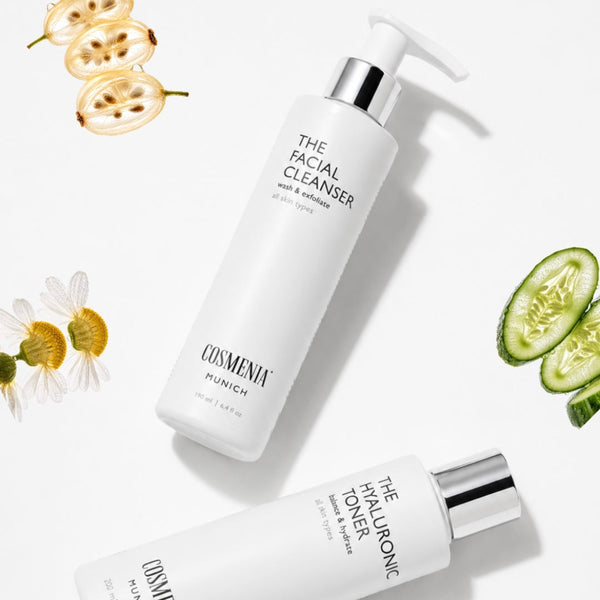
If you like hydrosols, you can use them as a gentle first step after cleansing – sprayed on or applied to a cotton pad. For real hydration, however, the skin also needs moisture-binding ingredients. That's why Cosmenia's The Hyaluronic Toner combines soothing chamomile with hyaluronic acid in different molecular sizes that actually hold moisture in the skin rather than just wetting the surface.
Prepare with cleansing
The Facial Cleanser with mild AHA fruit acids gently prepares the skin for the following toner without disturbing the barrier with aggressive surfactants – a good basis before hydrosols or toners can work at all.
As a complete routine
If you're looking for a matched cleanser and toner, the Cleanse & Balance Set offers both steps in a value pack – with active ingredients that go beyond the mild but limited effect of pure floral waters.
Frequently asked questions about hydrosols
Are hydrosols the same as essential oils?
No. Hydrosols are the watery by-product of distillation and contain only traces of the highly concentrated, fat-soluble aromatic compounds found in the essential oil. This makes them milder, but also much lower in active compounds.
Can I use hydrosols on their own as a moisturiser?
As your only moisturiser, they're usually not enough. They lack the moisture-binding and barrier-supporting ingredients that a cream or a functional toner with hyaluronic acid or ceramides provides.
Do hydrosols such as witch hazel water close pores?
Not in the physiological sense. Pores can't actively open or close. An astringent effect is usually temporary and cosmetic, not structural.
Conclusion
Hydrosols are a mild, pleasant natural product with documented but limited laboratory potential – a nice addition to daily care, but no substitute for ingredients with clinical evidence. If you want to combine moisture and soothing with truly effective ingredients, you'll find it in Cosmenia's Hyaluronic Toner.
Want to see more from COSMENIA in your Google search results? Add us as a preferred source.


Comments