Milky Toner: What the K-Beauty Trend Really Does – and When a Hydrating Toner Is the Better Choice
Note: image partly or fully created with AI.
The short answer
A milky toner is a milky facial toner with a small amount of oil and emulsifier – a cross between a toner and a light lotion. It cares for dry skin a little more richly. For most skin types, a hydrating toner with hyaluronic acid plus serum and cream achieves the same goal, just more flexibly.
Milky toner at a glance
- What it is: an emulsion of water, humectants, a little oil and an emulsifier – hence the milky look.
- Typical ingredients: glycerin, ceramides, panthenol, rice or oat extracts, light plant oils.
- Well proven: humectants such as glycerin and hyaluronic acid measurably increase skin hydration.
- Partly proven: protection against moisture loss – the small oil content helps a little but does not replace a cream.
- Not proven: “glass skin” from a toner alone.
- Trend: search interest has risen sharply since 2025, driven mainly by K-beauty.
What is a milky toner?
A milky toner is a liquid skincare product that sits between a classic toner and a light moisturising lotion. The difference to a clear toner: an emulsifier binds a small amount of oil to the water phase – which creates the milky colour and the soft, “cushioned” skin feel. There is no fixed definition; “milky toner” is a marketing term, and formulas vary greatly from brand to brand.
The idea fits the big skincare theme of recent years: instead of harsh peels, the focus is on an intact skin barrier. Find out how to recognise a damaged skin barrier in our guide.
Milky toner vs. hydrating toner: the difference
Texture and formula
A hydrating toner is a clear, watery toner with humectants such as hyaluronic acid, glycerin or betaine. It absorbs within seconds, leaves no film and can be layered as often as you like. A milky toner also brings some lipids – pleasant when skin feels tight, but also a bit of “cream” in the first step of your routine.
Who benefits from a milky toner
Very dry or mature skin during heating season benefits most, as do people who would prefer to apply just one single product in the evening.
When a hydrating toner is the better choice
For combination, oily or blemish-prone skin, oils and emulsifiers in a toner can be too much. Sensitive skin also often does better with a lean formula. And if you already use a serum and cream, you usually don’t need the lipids twice.
A critical look: what the research really shows
There are no studies on “milky toner” as a product type – what is proven is the effect of individual ingredients. Hyaluronic acid is the best researched: in a placebo-controlled study with 76 women (Pavicic et al., 2011), formulations with 0.1% hyaluronic acid in five molecular sizes significantly improved skin hydration and elasticity after 30 and 60 days. Only the smaller molecules (50 and 130 kDa) also reduced wrinkle depth – presumably because they penetrate the upper skin layer better.
Important context: the milky texture is mainly a skin feel, not an active ingredient. Even a well-formulated milky toner does not protect against moisture loss as well as a proper moisturiser. What counts is the INCI list – not the colour in the bottle.
Our recommendation: the milky effect through layering
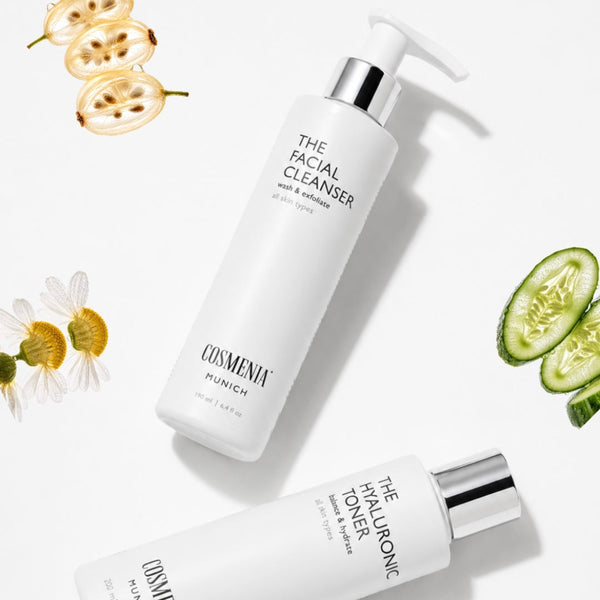
To be honest: our The Hyaluronic Toner is not a milky toner but a clear hydrating toner – and that is intentional. As a beautician, I see every day that skin responds best when hydration and lipids are applied separately and in the right dose. That way every skin gets exactly what it needs instead of a one-size-fits-all solution.
The formula contains plant-based hyaluronic acid, glycerin, betaine and sodium PCA – part of the skin’s natural moisturising factor – plus soothing chamomile flower water and refreshing cucumber fruit extract. The toner is 99% of natural origin, COSMOS NATURAL certified and rated 4.7 out of 5 stars from 175 reviews. The editors of GRAZIA have also recommended it.
How to get the milky glow with your routine
1. Cleanse: morning and evening with The Facial Cleanser.
2. Tone in layers: pat the toner into still slightly damp skin with your hands; add a second layer if your skin is dry.
3. Seal: follow with The Hydrating Serum and The Day Cream – they deliver the nourishing ingredients a milky toner packs into one bottle, just more precisely.
All four steps are available at a special price as The Glow Routine.
Frequently asked questions about milky toner
Is a milky toner better than a regular toner?
Not necessarily. A milky toner is richer and suits very dry skin; a hydrating toner is lighter and suits more skin types, especially combination and blemish-prone skin.
Can a milky toner replace a moisturiser?
Sometimes for normal skin in summer, but usually not. The oil content is too low to slow moisture loss as effectively as a cream.
Is a milky toner suitable for oily or blemish-prone skin?
Only to a limited extent. Oils and emulsifiers can be too much for oily skin – a clear toner with hyaluronic acid is usually the better choice here.
Should I apply toner with a cotton pad or with my hands?
For hydrating toners, your hands are ideal: less product is wasted and you can gently pat in several layers. A cotton pad is useful if you also want to remove residue.
Which natural toner is good for dry skin?
Look for humectants such as hyaluronic acid, glycerin, betaine or sodium PCA and for soothing plant extracts. One example is The Hyaluronic Toner, combined with a richer cream.
Conclusion
The milky toner is a pleasant trend for very dry skin, but not a miracle product: the effect comes from the humectants, not from the milky texture. If you want to layer hydration and care flexibly, a hydrating toner plus serum and cream gives you the same glow – for every skin type. Try The Hyaluronic Toner: shipping is free from €28, and your first order is covered by our 30-day money-back guarantee.
Wondering whether you need a separate serum as well? Read our check Extra hyaluronic acid serum: worth it or unnecessary?
Sources
- Pavicic T. et al. (2011): Efficacy of cream-based novel formulations of hyaluronic acid of different molecular weights in anti-wrinkle treatment. Journal of Drugs in Dermatology 10(9): 990–1000.
- Farwick M. et al. (2011): Fifty-kDa Hyaluronic Acid Upregulates Some Epidermal Genes without Changing TNF-α Expression in Reconstituted Epidermis. Skin Pharmacology and Physiology 24: 210–217.
- Martin R. (2026): The Best Milky Toners for Glowing, Glass Skin, with comments from Dr Sonia Khorana. Grazia UK.
Last updated: October 2026


Comments