
Ectoin in Skincare: What the Extremophile Ingredient Can Really Do for Stressed Skin

The short answer
Ectoin is a natural cell-protecting substance produced by extremophile bacteria to survive in deserts and salt lakes. In skincare, it binds moisture over several days, stabilises cell membranes and has been shown to protect against UV and environmental stress. For a natural cosmetics ingredient, the research is unusually solid – although a large part of the data comes from the main producer itself.
What actually is ectoin?
Ectoin (also spelled ectoine) belongs to the group of extremolytes – small, water-soluble molecules produced by so-called extremophile microorganisms to survive in hostile conditions. The bacterium Halomonas elongata, found in salt lakes, desert soils and hot springs, gave it its name. To avoid drying out there, it stores ectoin in its cells, which binds water in a stable shell around proteins and cell membranes – the so-called ‘hydro complex’. For the cosmetics industry, the ingredient is now obtained not from wild strains but biotechnologically through fermentation, similar to other marine fermentation ingredients.
How does ectoin work, scientifically speaking?
Unlike classic humectants such as glycerin, ectoin doesn't simply attract water but stabilises structures at a molecular level. A study published in 2026 in the International Journal of Cosmetic Science shows in human keratinocytes and fibroblasts that ectoin activates hyaluronic acid synthesis (HAS-2) and the aquaporin-3 channel – a water channel that regulates the distribution of moisture in the skin – while inhibiting UVB-induced collagen breakdown via MMP-1. In controlled application studies on dry and atopic skin, formulations containing ectoin noticeably improved dryness, roughness and irritation scores compared with baseline. In mechanically or laser-irritated skin, too, an ectoin emulsion reduced transepidermal water loss and redness in a study published in 2025. A depot effect is also remarkable: after around 12 days of regular use, the moisturising effect lasts for several more days even after the product is stopped.
A critical look: how robust is the research really?
Compared with many other current trendy ingredients, the data on ectoin is unusually extensive – the substance has been studied medically for over two decades in ophthalmology and for respiratory irritation, not just in cosmetics. This creates a more solid foundation than with pure hype molecules. One point of criticism remains, though: a considerable proportion of the studies cited come from the main producer of the patented raw material brand or were carried out on its behalf – independent, third-party-funded long-term studies with large numbers of participants are rarer. In addition, many of the most impressive results relate to concentrations of 1–7%, while the actual concentration in finished cosmetic products is often not declared. So if you're looking for a proven effective dose, you won't automatically find transparency on the label. The safety profile is positive: even at higher concentrations, hardly any intolerances are reported, which makes ectoin interesting for sensitive and atopic skin – provided the overall product is well formulated for tolerability.
Adding ectoin to your routine the smart way
Building moisture with fermented and plant-based ingredients
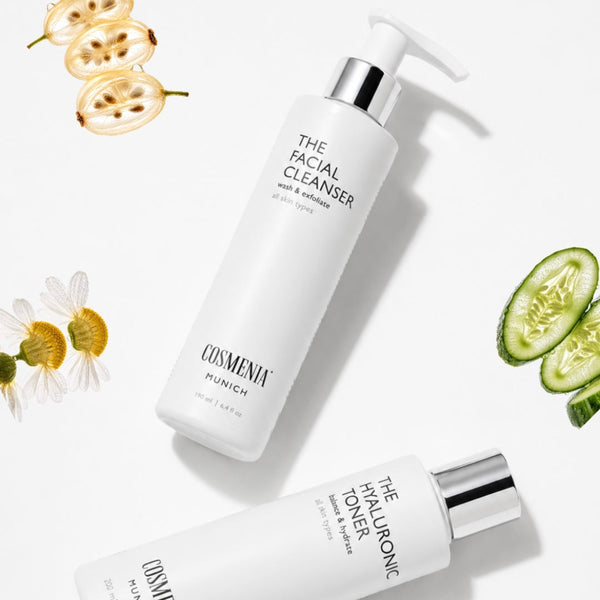
If you want to try ectoin, rely on a routine that already builds up moisture in a structured way. Our Hyaluronic Toner with hyaluronic acid and chamomile prepares the skin as the first step and creates the basis on which water-binding ingredients such as ectoin can work better.
For irritated, reactive skin
Since ectoin has mainly been studied on atopic and stressed skin, it goes well with light, soothing care. Our Glowy Gel with aloe vera and zinc absorbs quickly and doesn't put any extra strain on the skin – a sensible basis for sensitive or blemish-prone skin.
UV protection as a sensible addition
Since part of ectoin's documented effect targets UV-induced stress specifically, the ingredient doesn't replace sun protection but complements it. During the day, combine ectoin-containing care with our mineral Sun Kiss SPF 30 to actively prevent collagen breakdown and cell stress caused by UV radiation.
Frequently asked questions about ectoin
Is ectoin suitable for sensitive skin?
Yes. Ectoin is considered very well tolerated, even at higher concentrations, and has been studied positively on atopic and irritated skin in particular. However, how well the overall product is tolerated always also depends on the other ingredients.
Is ectoin natural in the sense of natural cosmetics?
Ectoin is now produced biotechnologically through fermentation by microorganisms, not synthetically from petrochemicals. It is therefore generally considered a raw material compatible with natural cosmetics, but this should be checked in detail depending on the certification standard.
Can ectoin replace retinol or vitamin C?
No. Ectoin works primarily in a protective and moisture-stabilising way, not as a classic anti-ageing ingredient with direct collagen stimulation like retinol. The two classes of ingredient tend to complement rather than replace each other.
Conclusion
Ectoin is one of the few trendy ingredients whose effect is comparatively well documented even outside the manufacturer's marketing department – the molecular mechanisms of action are comprehensible and tolerability is high. If you read the figures critically, you should still bear in mind that a large proportion of the studies were produced close to the manufacturer and that the actual concentration in finished products is rarely transparent. As an addition to well-thought-out barrier care, ectoin is a sensible choice – especially for skin suffering from UV stress, dryness or irritation. Our Hydra Barrier Repair Set offers a good start to such a routine.
Want to see more from COSMENIA in your Google search results? Add us as a preferred source.


Comments