
Collagen Boosters in Natural Cosmetics: Plant Peptides vs. Anti-Ageing Promises

Note: image partly or fully created with AI.
The short answer
Strictly speaking, ‘plant collagen’ doesn't exist – collagen is an animal structural protein. What natural cosmetics sell as ‘collagen boosters’ are mostly plant-based signal peptides that are meant to stimulate the skin's own collagen production. For some of these peptides, independent studies show measurable effects on skin density and wrinkle depth after eight to twelve weeks – but for many products on the market, this proof is simply lacking.
Why collagen in a tube usually doesn't deliver what the name promises
With a molecular weight of around 300,000 daltons, collagen is one of the largest proteins in the body and is structurally simply too large to penetrate the stratum corneum into the dermis – where the body's own collagen is actually formed. Collagen in a cream stays on the skin's surface, forms a moisture-binding film there and can make the skin look plumper in the short term. That is a legitimate cosmetic effect, but not a rebuilding of the skin structure, as the product name often suggests.
It gets even more confusing with ‘plant-based’ or ‘vegan’ collagen: plants don't biologically produce this protein at all. What is sold under this name is either a mix of the amino acids that make up collagen (glycine, proline, hydroxyproline, lysine) or a collagen analogue produced through genetic engineering or fermentation. Both can be useful ingredients – but the term ‘plant collagen’ is more marketing than an accurate description of the ingredient.
What signal peptides actually do
The really interesting mechanism behind many ‘collagen boosters’ is signal peptides, often also called matrikines – short chains of amino acids that send fibroblasts a signal: ‘Collagen has been broken down here, produce more.’ The best-known example is the Matrixyl family of ingredients based on palmitoyl tripeptides. Unlike applied collagen, these peptides are small enough to penetrate deeper layers of the skin and address the actual cause there: the declining collagen synthesis of the body, which decreases continuously from the mid-20s.
There are now also plant-based signal peptides, obtained for example from fermented rice or soy proteins, which are said to work in a similar way to their synthetic counterparts. The research on these is considerably thinner than for established ingredients such as Matrixyl – promising, but not yet as widely independently confirmed.
A critical look: where the evidence holds up and where it doesn't
For signal peptides that stimulate collagen, there are several independent, placebo-controlled studies showing a statistically measurable increase in skin density and a reduction in wrinkle depth after eight to twelve weeks of regular use. That's a more solid basis than for many other trendy anti-ageing ingredients.
The picture is different for oral collagen supplements, which are often lumped together with topical collagen boosters in advertising. A meta-analysis published in September 2025 concluded that no clinically robust effect of collagen powder on skin ageing can be demonstrated once only high-quality, independent studies are considered – earlier positive results came mainly from manufacturer-affiliated studies with small numbers of participants. If you hear ‘collagen booster’ and automatically think of drinkable ampoules, you're comparing two product categories with very different levels of evidence.
Another point of criticism: many cosmetic products advertise ‘collagen-stimulating ingredients’ without disclosing the actual peptide concentration. Since the efficacy of signal peptides depends on concentration, merely naming the ingredient on the packaging says little about the effect you can expect.
Adding collagen boosters to your routine the smart way
Cell protection as the basis for the skin's own collagen formation
Collagen synthesis needs an intact, well-supplied skin environment. The Hydrating Serum with Alteromonas ferment extract supports the cells in regenerating rather than just supplying superficial moisture – a good basis before targeted active ingredients can even take effect.
Strengthen the barrier so that active ingredients can work
As with most active ingredients: without an intact skin barrier, even the best signal peptide fizzles out. The Day Cream with plant lipids and sea buckthorn keeps the barrier stable, creating the conditions under which collagen-stimulating care can take effect at all.
Keep moisture visible while collagen formation slowly catches up
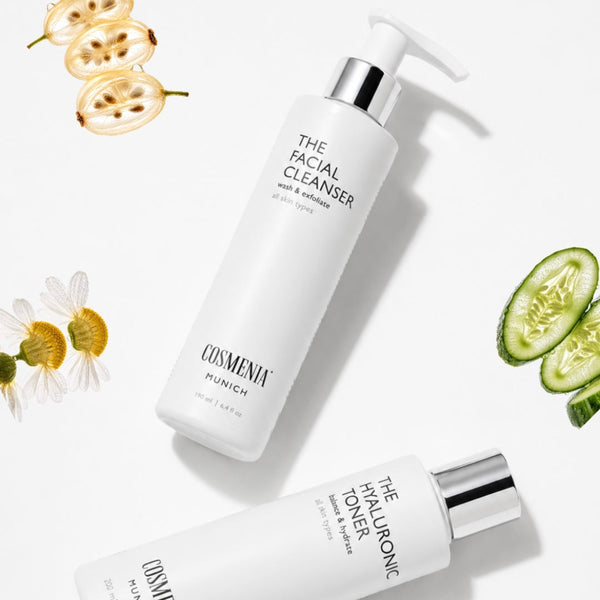
Since signal peptides only become visible after weeks, an ingredient that makes the skin look plumper in the short term is worthwhile in the meantime. The Hyaluronic Toner bridges this time with hyaluronic acid in several molecular sizes, without making false promises about collagen formation itself.
Frequently asked questions about collagen boosters in natural cosmetics
Does a cream with collagen do anything at all?
It can smooth the skin and provide moisture in the short term, because collagen acts as a film former. Due to its molecular size, however, it does not rebuild the skin matrix structurally like the body's own collagen.
What distinguishes collagen boosters from pure collagen in a product?
Collagen boosters – mostly signal peptides – don't contain collagen itself but stimulate the skin to produce more of it. Of the two, this is the scientifically better-supported approach.
How long does it take for a collagen booster to show visible results?
Experience shows eight to twelve weeks of regular use, as the body's own collagen synthesis takes time. If you expect immediate effects, you'll be disappointed – short-term plumpness comes more from moisture-binding ingredients such as hyaluronic acid.
Conclusion
‘Collagen booster’ is an umbrella term for approaches with very different levels of evidence: applied collagen works superficially and in the short term, while plant-based signal peptides target the body's own production and do show measurable effects in independent studies – but only after weeks and not at every concentration. If you want to build a routine based on comprehensible mechanisms rather than the word ‘collagen’ alone, the combination of cell protection, barrier care and moisture in the Hydra Barrier Repair Set is a well-founded starting point.
Want to see more from COSMENIA in your Google search results? Add us as a preferred source.


Comments